Friday, December 5, 2008

Blogging Experience

Reflection on Blogging

Having created a blog for a previous class and not enjoying the experience I was skeptical that I would appreciate another attempt at blogging. I think the assigning of topics for the first part of the semester facilitated active participation in the assignment. I was assigned clicker technology, which I had no prior experience with. Had I chosen my own topic that I had knowledge of I may have edited details that I knew but others did not. The use of a novel topic made the experience beneficial to the blogger and the commenter alike.
I appreciate the interaction with a wider audience a blog may foster. A blog is great vehicle to bring individuals interested in common topic together and share their ideas. Searches online increasingly point to pages where users may comment on the topic of the page. In my experience the posted comments often add to a better understanding of the topic and lead to other helpful references.
In order to improve my blogging I think I would try to find some helpful tips for effective blogging, perhaps elements of style. For example, limiting posts to 100 words and including open-ended questions to encourage comments from users may improve a blog’s success. Is it better to have multiple short posts or long posts that appear less frequently?
As for usage in the classroom blogs may be used to encourage reluctant students to write and improve their writing style. Students may be more engaged in their writing when given the opportunity to write on topics important to them and connect to others interested in those topics.

Saturday, November 22, 2008

Library Project

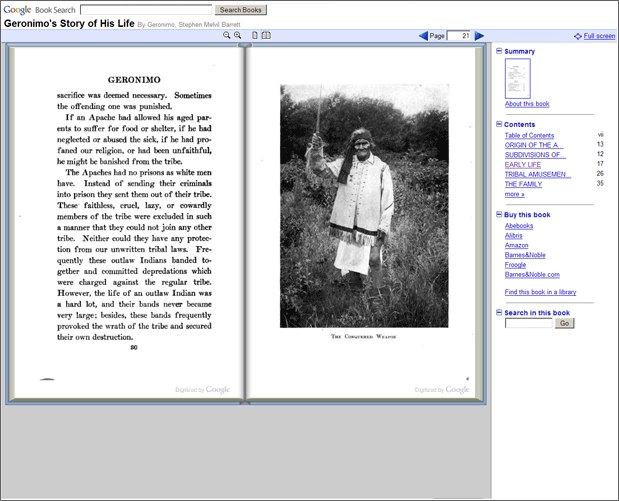
Google Books Library Project – An enhanced card catalog of the world's books

This project much like the publisher endeavor but works with university libraries to place their collections online. The major benefit of this is giving wide access to many rare and out of print texts, while ensuring further damge to those texts will not be encured.

Goal:
The Library Project's aim is simple: make it easier for people to find relevant books – specifically, books they wouldn't find any other way such as those that are out of print – while carefully respecting authors' and publishers' copyrights. Our ultimate goal is to work with publishers and libraries to create a comprehensive, searchable, virtual card catalog of all books in all languages that helps users discover new books and publishers discover new readers.

Partners:

Here the University of California discusses their involvement in the project:

Thursday, November 20, 2008

Partner Program

You may learn more about how publishers may partner with Google in order to promote their books here:


Here are forward thinking publishers talking about Google and how it will play into their future plans:

Sunday, November 9, 2008

Improved Access

According to Google there are currently 7 million text available in there library. 1 million in full preview mode as part of formal publisher agreements. Another 1 million are public domain works. This means that these 2 million texts may be fully accessed via the web without the need of obtaining a hard copy. Most of the other 5 million aren't in print or commercially available. Google today can only show snippets of their text.

In comparison Sun’s libraries contain 3.18 million volumes, which are only available through their on campus libraries.

Through the Google Book Search anybody may have access to the materials and at the same time. Hard copies may only be used by one user at a time. Have you ever been frustrated by the materials placed on hold by a professor for an entire class?

Another limitation to the hard copy model is the limited space within brick and mortar libraries. There are only so many volumes a building may house. Either new facilities have to be built or volumes eliminated in order to make space. With the Google model older texts may be archived off campus and made available via the internet using their service. This would lead to access maintained to these volumes at little additional cost, certainly less than building new libraries.

Google Book Search

For the second half of the semester I will be looking at the controversial Google Book Search program. I know very little about the project besides the basics; which is scanning texts and making them availiable on the net.

Outline of functions:

Search
Book Search works just like web search. Try a search on Google Book Search or on Google.com. When we find a book with content that contains a match for your search terms, we'll link to it in your search results.

Browse books online
If the book is out of copyright, or the publisher has given us permission, you'll be able to see a preview of the book, and in some cases the entire text. If it's in the public domain, you're free to download a PDF copy. Learn more about the different views.
Learn more -- fast
We've created reference pages for every book so you can quickly find all kinds of relevant information: book reviews, web references, maps and more. See an example.
Buy the book ... or borrow it from the library
If you find a book you like, click on the "Buy this book" and "Borrow this book" links to see where you can buy or borrow it.
Where do the books come from?
Currently, we are connecting readers with books in two ways: the Partner Program and the Library Project.

Looking closer at the site I have used this service many times. I was thinking about just covering the scanning of the books, which has been a hot topic lately. To me the most frustrating is finding the right book at your local library. Google Books is the search engine for the world's library. This tool helps to find books on the topic I'm interested in and where I can find them. It also allows me to review the materail and how it is rated by other users. These ratings helps to identufy quality material with little effort, a function that alot of our Web2.0 technologies have had. I have used this tool as my main library search tool and either took the book out from a local library or requessted it from interlibrary loan. If you haven't used inter library loan yet I highly suggest it, this servive greatly expands what is availibale to you. Nothing like receiving books from around the country at your own library.

Clicker Conclusion

Upon learning what classroom clicker technology was intrigued in its real world implementation. The positive outcomes from this technology include real time feedback on student outcomes, assessment understanding of topic material. Maintaining learners actively engaged was also a highlight of clicker use. Use of clickers outside of the classroom for surveys, homework, and tests was also mentioned for possible uses.

Drawbacks of the technology of the included upstart costs, training of users, and the practical effectiveness of the clickers use. Any technology would have the same drawbacks and in order for technology to be properly implemented each distinct situation must be evaluated.

I just returned from a conference where a clicker vendor was on hand. I enjoyed being able to hear their pitch and to try the technology for myself after reading about it in past couple of months. In the end I think clicker technology is best used in large class formats where interacting with each student is much more difficult. In smaller classes a good teacher should be able to engage the learner and keep them interested. I think the cost of clicker technology in smaller settings would not be cost effective. Of course the learner must make the effort to be actively engaged. In larger settings techniques used in smaller venues are not as viable. I can see clickers being much more cost effective in larger lecture classes.

Sunday, October 5, 2008

Cost Reduction


So it seems that audience response systems work and can be found in classrooms with increasing regularity. As mentioned in an earlier post cost may be prohibitive in some applications. Cost effectiveness and simplicity are very important to me. So for me to use this technology I would need for it to not necessitate me to buy any new gadget and the service would need to be cheap. I think I have found a service that satisfies these two qualifiers for my adoption of the technology.

http://www.polleverywhere.com/how-it-works

Poll Everywhere utilizes the web to collect data through text messages and post them live. This method takes advantage of the almost ubiquitous ownership of cell phones, no need to buy any equipment. Of course the service does cost, but the availability of several scalable plans allows a user to custom fit it to there needs and means.

http://www.polleverywhere.com/plans/Free

At least this option would allow an organization to try audience response methods without a large investment.

Friday, September 26, 2008

University of Delaware Responds to Classroom Clickers

http://campustechnology.com/articles/49681/

An interesting article I came across on how clickers become common place on a campus. in this situation campus officials responded to a number of instructors trying the technology out for themselves, kind of like a grassroots start up. Administration did not want several systems to be used and have to support each. Also they did not want to burden students with having to buy multiple devices for their classes. It seems a bit much to ask students to buy this technology, should this be optional? I guess if it will be used in multiple classes and is beneficial to both students and instructors the cost is worth it over a four year period. Although what if only a minority of classes use it? Certainly we all have had classes where the instructor doesn't use the text they had you buy or not enough to justify the cost.

Sunday, September 14, 2008

Clickers/Polling technology

Clickers/Polling technology

I wasn't sure what this technology was going to be until I looked it up. Surprisingly I had heard of this technology before and was quite interested in it. Clickers and pollers are used in class to assess the class' understanding as a whole on a certain topic or even to allow the class to direct the flow of the class through voting. Basically clickers and pollers allow the class to vote or answer question during class. These are tallied in real time and are available for the instructor to make decisions in class, perhaps reviewing a topic in a different way if most students responded incorrectly. I'm always interested in the cost of technology and its effectiveness. This technology is not cheap and may be broken in careless hands. Note most schools have graffiti and I'm sure the same student artists would have no problem filling their class time breaking these units. I found this article that made the case to use cell phones in there place to solve this potential problem.

http://themobilelearner.wordpress.com/2007/11/27/polling-by-cell-phone-can-we-completely-by-pass-clickers/

http://news.cnet.com/2300-1041_3-5819187-1.html?tag=mncol

First Post

This is my second blog for class. Hopefully I'll be a little more active than I was before. I'm more of an internal learner, thinking through things on my own rather than openly debating them. With set topics though I'll try to find info that not only interests me but you as well. Perhaps taking a different approach to topic than you may have.

Monday, February 25, 2008

Management of Instruction

ID Model’s Goals/Objectives
The goal of the model is to provide a guided approach to altering the common held beliefs of a group through identifying peer leaders, training, and diffusion of information. While much of the information provided will not be new the novel presentation of that information through peers will hopefully be more effective at changing their behavior.

Supra-system Goal
The goal of the supra-system is shared by the ID model goal. Both hope to better inform students on alcohol use and to reduce the number of problem drinking episodes experienced.

Method of Delivery
Research staff will identify peer leaders and conduct instructional meetings on what/how to present/interact with their peers as leaders. Perhaps an online community could be created to offer remote support and allowing peer leaders to interact with each other.

Method of instruction
Lectures and group role-playing will be the main method of instruction. First students will need to know the reasoning behind this approach and information that will be conveyed. This will be done in a lecture format with question/answer sessions interspersed. Most importantly role playing will be used so peer leaders will get a feeling of how to broach this subject, which will lead to a heightened comfort level when put into practice. Follow up sessions in smaller groups may be used to ensure proper implementation in the field.

Logistical/Administrative Problems
As mentioned previously the largest problem is with data collection. Without clearly identifying a solution to this problem evaluation of the project will be nearly impossible. Several different methods may be followed including peer leader journal, surveys, and public records.

Wednesday, February 13, 2008

Model Status

Model Status Report

This model will be based up on a new research project looking at opinion leader within social networks and their effect on moderating negative outcomes caused by alcohol consumption. We would like to use the phenomena of "word of mouth marketing" through selected peer opinion leaders to alter the drinking behavior of a larger community, for example a single dorm on campus. This new direction interests me for its' potential to affect a larger number of people(efficiency), could be more cost effective, and the utilization of established yet growing social networks for the promotion of public health. This approach has never been taken with campus drinking. This program will be created from scratch using examples from HIV prevention strategies and from marketing strategies.

I see this project being completed in five stages.

1. Development
- procedure for identifying peer leaders
- define desired behavior to be carried out by peer leaders
- creation of training program for recruited peer leaders
- data collection process outlined(surveys/journals/referral records)
- establish collaborative relationship with outside departments(Residence Life)

2. Seek Institutional Review Board Approval

3. Pilot study to show proof of feasibility and to evaluate procedures

4. Implementation
- identification and recruitment of peer leaders
- training of peer leaders
- data collection
- maintenance of project(feedback) adjustments made as needed

5. Data Analysis and Final Reports

I’m still a little unsure of this model; perhaps it is over simplified in this status report. Certainly the evaluation of the project through data collection will be a hard procedure to define and implement. As for the final model I am unsure what that will look like. Will the final model be a general model based upon this project but would be used by other future projects as a guide?

Thursday, February 7, 2008

Module 3

1. Information Channels

The channel between the researcher/instructor and the peer leader must be created. First we will need to decide how to open this channel and how to foster it during the project. Initial recruiting contacts may be through email and phone calls. As the peer leader becomes more involved in the project a more personal approach must be taken, for example face-to-face contacts. Certainly training of peer leaders must be done in person. Follow-up training as needed may be completed both in-person and by other methods such as email and phone calls. The method of follow-up training will be left to the discretion of the researcher. Data collection addressing the interaction of peer leaders with their peers may be completed through interviews and/or journal entries by the leaders.

The peer leader/peer channel has already been open through casual interactions prior to the start of the project. Additional new interactions will continue to arise through the normal socialization of the peer leader in the community. These interactions may take place through in person conversations, phone calls, emails, and Facebook postings. Our project is mainly interested in the casual conversations that take place in social situations. These conversations already take place and we merely aim to add the discussion of the negative consequences of excessive drinking. Basically we’d like to take advantage of an established channel to promote our message.

2. Innovation-Decision Process

A. Knowledge Step
The step would be the research team collecting the relevant information about the field of this project, use of peer leaders in public health initiatives. From this a detailed plan of the project will be developed and package created to pitch the project to the potential stakeholder groups.

B. Persuasion Step
Upon developing the project the proper offices will be presented the aim of the project. This pitch will be made to the proper decision makers at Residence Life and perhaps pitches will have already been made to opinion leaders within the organization. In doing so hopefully we will already have out foot in the door.

C. Decision
This will be made by the Office of Residence Life. In order insure that our program will be supported ORL will be involved in developing the project so that any problems with the program will have been addressed prior to the final pitch of the project being made. Other decision makers will also include the Institutional Review Board and the granting body we will be seeking funding from.

D. Implementation
Implementation will be taken on by the research team and the peer leaders to be recruited. Due to the nature of research the protocol of implementation will be strictly followed as planned.

E. Confirmation
The project will be continuously monitored to ensure the protocol is being followed. Any changes that may be needed will be addressed as the need arises. The success of the project will be determined through the data collected and may guide future projects.

3.Other Factors

Identification of actual peer leaders will be crucial. More importantly chosen leaders must want or be sufficiently motivated to complete the tasks asked of them. Also will we use upper class students with already established social networks or freshmen with newly forming networks? It should be noted that the group that experiences the most negative consequences attributed to their drinking are freshmen. Also the scale of the community that will be targeted should be considered. Certainly a campus wide program could be overwhelming and targeting several smaller dorms may be a better approach to show proof of feasibility.

Tuesday, February 5, 2008

Module 2 Model Exercises

Model Exercise A

1. Front End Analyses
A. Define problem in qualitative terms. Must be able to describe the current drinking behaviors on campus and after the Peer leaders have been utilized.

B. Evaluate long-term effects, more importantly determining how to measure any effects.

C. Develop Components of Solution. How will peer leaders be identified and recruited to participate. What motivation will be provided for their participation? Create training program for peer leaders and follow-up training as necessary.

2. Chapter 6

For this project we’re hoping to provide the opportunity for a series of personal (micro) interactions to change the behavior found within the larger (macro) system. This interaction between micro and micro has been studied but isn’t fully understood how to effectively promote change through this approach. Hopefully through this process we can better describe this phenomenon.


Model Exercise B

1. Needs
A. Statictically significant reduction of problem drinking behaviors within the dorm.

B. Identification of opinion leaders.

C. Effective instruction of peer leaders.

2. Priority

1. ID peer leaders
2. Instruct peer leaders
3. Reduction in problem drinking

3. Things to consider during FEA

- ability to correctly ID peer leaders
- clearly quantifying outcomes
- creating effective measurement tools
- how will the peer leaders be used within the dorm
- will Office of Residence Life cooperate with the program

Monday, January 28, 2008

Model Sketch-up

The research project I currently work on deals with individual interventions with students that have violated the campus alcohol policy. The project seeks to determine how effective each of the three interventions are at modifying an individual's drinking behavior. We are now looking at a different approach for the next project.

We would like to use the phenomena of "word of mouth marketing" through selected peer leaders to alter the drinking behavior of a larger community, for example a single dorm on campus. This new direction interests me for its' potential to affect a larger number of people(efficiency), could be more cost effective, and the utilization of established yet growing social networks for the promotion of public health. This approach has never been taken with campus drinking. This program will be created from scratch using examples from HIV prevention strategies and from marketing strategies.


System: Syracuse University Campus Community

Suprasystem: Residence life

Subsystems:
Residence Assistants that deal directly with the student population and Residence Directors that deal with students in violation of alcohol policy.

Research team which identifies the peer leaders, conducts their training, monitors the program, and collects data.

Information Channels:
Peer leader -----> Students
Office of Residence Life
Students -----> Research Team

Subsystem Interface: Data collection through interviews and surveys. Emails. Interaction between peer leader and students.